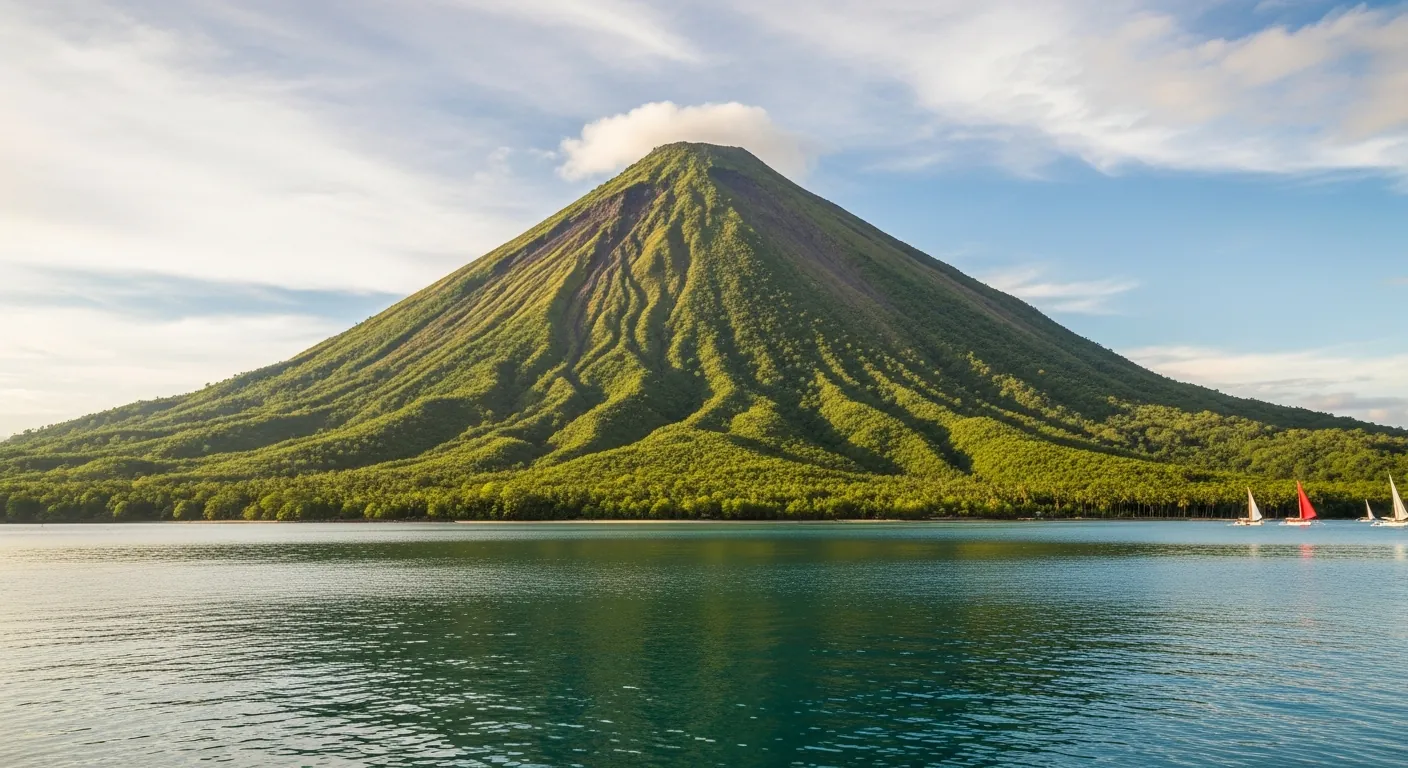
The air on Tidore, thick with the scent of volcanic soil and distant sea salt, carries whispers of ancient trade routes and sultanate power. Here, the equatorial sun warms the slopes of Kie Matubu, a sentinel volcano overseeing a history etched in cloves and colonial rivalries.
The Volcanic Heart of Tidore: Kie Matubu and its Embrace
Tidore Island, a prominent volcanic island in the Maluku Islands archipelago, stands as a sign of geological forces and historical resilience. Its landscape is dominated by Kie Matubu, a stratovolcano rising to an elevation of 1,730 meters (5,676 feet) above sea level. This active volcano shapes not only the island’s topography but also its agricultural fertility, providing the rich soil essential for the growth of spices. The island lies west of Halmahera in North Maluku Province, Indonesia, a strategic position that historically connected it to extensive maritime trade networks. The volcanic activity has created a rugged coastline interspersed with small coves and black sand beaches, offering a stark beauty. Geologically, Tidore is part of the Pacific Ring of Fire, a zone of frequent earthquakes and volcanic eruptions, yet its slopes have sustained communities for centuries. The island’s circumference measures approximately 60 kilometers, making it traversable yet substantial enough to support diverse ecosystems, from coastal mangroves to highland rainforests. The island of Tidore is part of the City of Tidore Islands (Kota Tidore Kepulauan) administrative area, which also includes the smaller islands of Mare, Maitara, and Filonga, each contributing to the regional character.
Sultanate of Tidore: A Legacy of Spice and Sovereignty
Tidore’s history is inextricably linked to the Sultanate of Tidore, a former regional spice-trading power that wielded significant influence across Southeast Asia for centuries. Established in the 15th century, the Sultanate flourished through its control over the cultivation and trade of cloves, a commodity that drove global exploration and colonial expansion. Tidore was historically one of the principal clove-producing islands of the Maluku spice trade, attracting European powers like the Portuguese, Spanish, and Dutch, who sought to dominate this lucrative commerce. The Sultanate maintained its independence and often rivaled the neighboring Sultanate of Ternate, engaging in complex alliances and conflicts that shaped the political landscape of the Spice Islands. Fort Torre, built by the Portuguese in 1578, and Fort Tahula, constructed by the Spanish in the early 17th century, stand as enduring monuments to this era of intense competition and strategic fortifications. The Sultanate’s reach extended far beyond Tidore itself, encompassing parts of Halmahera, New Guinea, and other islands in the region. The legacy of the Sultanate is preserved in the current Sultan, who continues to serve as a cultural and ceremonial leader for the Tidore people, upholding traditions that date back generations.
Forts of Tidore: Sentinels of the Spice Trade
The remnants of colonial fortifications dot Tidore’s coast, each stone narrating a chapter of imperial ambition and local resistance. Fort Torre, initially a Portuguese stronghold, stands near Rum village on the island’s eastern side. Its strategic position offered command over vital sea lanes. Further south, near Soasio, the ruins of Fort Tahula mark a Spanish presence, a sign of their attempts to secure a foothold in the spice-rich archipelago. These forts, constructed from local stone and coral, were not merely defensive structures; they were symbols of European power and centers of administration during a period of intense rivalry. The design of these forts, often featuring robust bastions and high walls, reflects 16th and 17th-century European military architecture adapted to tropical conditions. Visiting these sites offers a tangible connection to the centuries when Tidore Island was a pivotal point in global commerce and geopolitical maneuvering. The forts illustrate the constant struggle for control over the Maluku Islands, which were the sole source of cloves and nutmeg for centuries.
The Clove Sultanate: Economy and Culture Rooted in Spice
The economic bedrock of Tidore Island for centuries was the clove tree, *Syzygium aromaticum*. Tidore was historically one of the principal clove-producing islands of the Maluku spice trade, a fact that defined its prosperity and its place in world history. The cultivation of cloves shaped the island’s agricultural practices, land use, and even its social structure. Harvests, typically occurring between September and December, involved meticulous hand-picking and sun-drying processes that have largely remained unchanged for generations. The aroma of drying cloves still permeates the air in villages during these months. Beyond economics, cloves are woven into the cultural fabric of Tidore. They feature in traditional medicine, ceremonial offerings, and culinary practices. The Sultanate of Tidore, a former regional spice-trading power, leveraged its control over clove production to build and maintain its extensive influence. This deep connection to the spice trade fostered a unique maritime culture, as Tidorese sailors and traders navigated the waters of the Indonesian archipelago, exchanging goods and ideas. The cultural traditions of the Tidore people reflect this long history, with ceremonies and social customs often paying homage to their ancestral connections to the land and the sea.
Accessing Tidore: Gateways through Ternate and Maritime Routes
Access to Tidore Island primarily funnels through its neighboring island, Ternate, which hosts Sultan Babullah Airport (TTE). Regular flights connect Ternate to major Indonesian cities like Jakarta and Makassar. From Ternate, the journey to Tidore is a short and scenic maritime passage. Public ferries and speedboats depart frequently from Bastiong Port in Ternate, reaching Rum Port on Tidore’s eastern coast in approximately 30 to 45 minutes, depending on the vessel. The cost for a public ferry typically ranges from 15,000 to 25,000 Indonesian Rupiah, while speedboats are slightly more expensive but offer a quicker transit. These routes highlight the intricate network of Indonesian maritime trade routes that have sustained the region for centuries. Once on Tidore, local transportation includes *ojeks* (motorcycle taxis) and *angkot* (minibuses), which connect the main towns and villages. The island’s small size allows for relatively easy navigation, with the main road circling the base of Kie Matubu. The City of Tidore Islands administrative area, which includes Tidore Island and the smaller islands of Mare, Maitara, and Filonga, relies on these inter-island connections for daily commerce and travel.
Cultural Mix: Traditions and Daily Life on Tidore
The cultural traditions of Tidore people are a vibrant expression of their enduring heritage, shaped by centuries of interaction with diverse cultures through the spice trade and their unique island identity. The Sultanate of Tidore remains a significant cultural institution, with traditional ceremonies and royal protocols observed during important events. These rituals, often involving elaborate costumes and ancient music, connect contemporary Tidore to its illustrious past. Daily life on Tidore is a blend of traditional practices and modern influences, with fishing and agriculture continuing to be primary livelihoods. Village communities maintain strong social bonds, often centered around mosques and traditional meeting places. The local language, Tidore, is a Papuan language, distinct from the Austronesian languages common in much of Indonesia, reflecting the island’s unique ethnolinguistic heritage. Traditional arts, such as weaving and wood carving, are practiced, often incorporating motifs inspired by local flora, fauna, and historical events. Festivals and celebrations throughout the year offer insights into the island’s spiritual and communal life, often featuring traditional dances like the *Soya-Soya* and local culinary specialties. The architecture of traditional homes often incorporates natural materials, designed to withstand the tropical climate.
For those drawn to the deep currents of history and the raw power of nature, Tidore Island offers an unfiltered encounter with the past and present of the Spice Islands. Explore the authentic narratives of this ancient sultanate and its volcanic heart by continuing your journey on tidoreisland.com.